The undertow
Women don't avoid sovereign hobbies by accident; they get pulled back before they ever reach the water
It's 4AM and my suitemate's alarm has just gone off. I peered at my phone and did a mental calculation: I could get up now and eat a leisurely breakfast with others or go back to sleep for another half hour, walk to the main cafeteria, rush and grab tea, manage to digest a banana, and make the 4:45 departure to Aposentillo, a well-known surf break in northern Nicaragua. This calculation “sleep or breakfast" would repeat itself every morning for the next week as I settled into a women's-only surfing retreat I had signed up for, somewhat against my better judgement.
I had tried surfing twice before, in San Diego nearly fifteen years ago, but the frigid waters required a 5mm wetsuit year-round and I hated- still hate- being cold. That was enough to close the door. It also seemed like a sport that was overly time-hungry. I was busy enough, and surfing felt frivolous enough that it didn't seem worth the investment.
For those who know me, I am the queen of efficiency. I've structured my life such that the time I spend has to be productive, my hobbies accomplish something: self-care, health, service to others, creating something. I am also a night owl. So the idea of being awake at 4 a.m. at the whim of ocean tides was not only foreign, it was slightly infuriating. But as I started to paddle out, swimming over waves, turtling myself to avoid getting washed back to shore, I recognized something I hadn't yet been able to articulate: some hobbies wait for life to make room for them, and others require life to move aside. Surfing is firmly in the latter.
Surfing is strangely opposite to the rhythm of ordinary life, where most of us women organize leisure around whatever time remains after obligations have been satisfied. Work, family, errands, social duties come first, hobbies appear only in the leftover spaces. Surfing reverses that order. To surf seriously means structuring your life around the possibility of waves: checking forecasts, chasing conditions, rearranging plans when the ocean cooperates. You become obedient to something outside yourself, wind patterns, tides, swell direction. Yet at the same time it demands something remarkably self-focused: when you paddle out, you are removed from ordinary life. Emails go unanswered, chores remain undone, and whatever responsibilities you carry on land must be handled by someone else while you are in the water.
Standing on the beach one morning, watching the sun rise while we waxed our boards, I found myself recognizing a pattern I had never quite named before: women have been steered toward hobbies that happen when life allows them, while men get to pursue hobbies that require life to move aside.
That pattern needed a name, so I started sketching what I now think of as a hobby matrix.
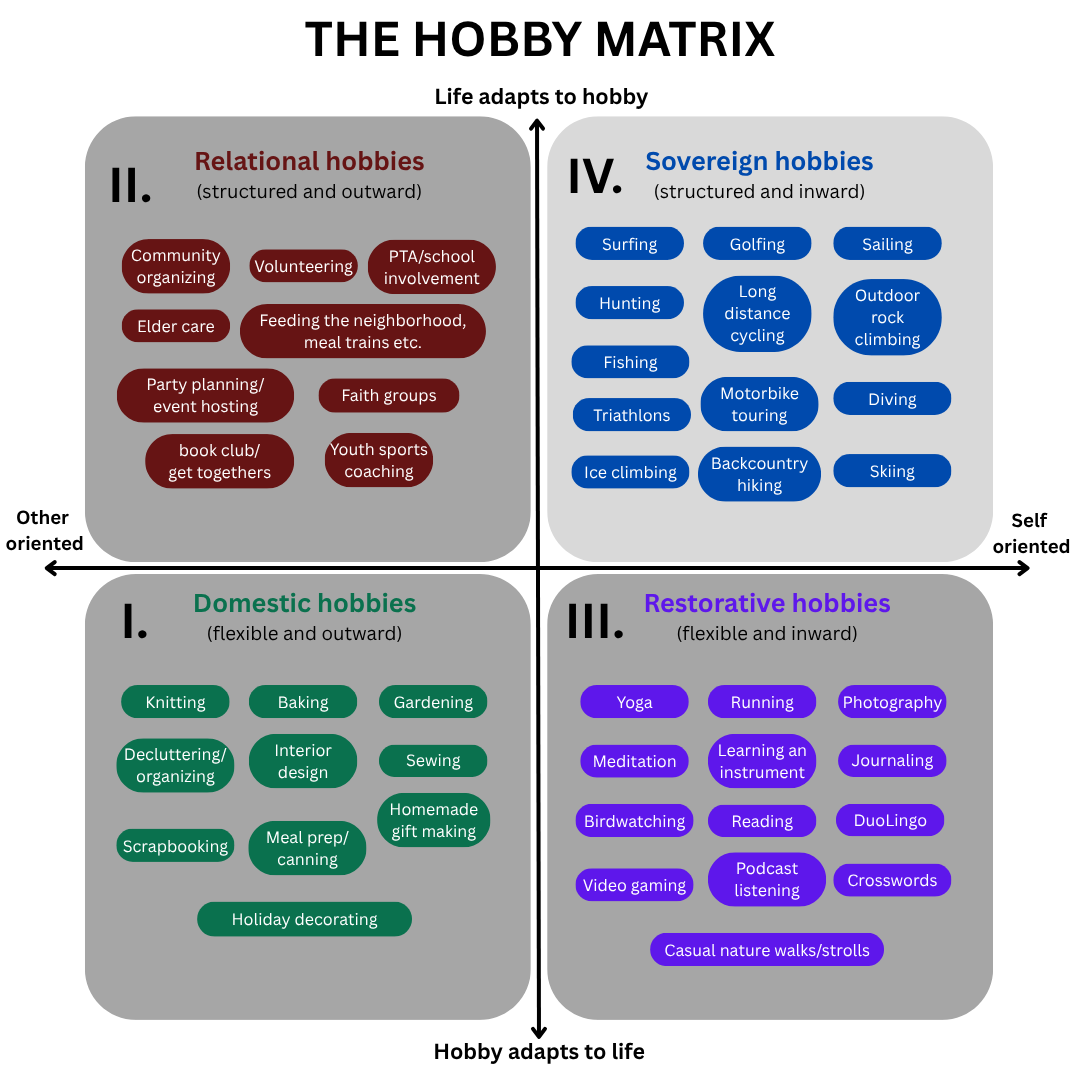
On one axis is a simple question: who does the hobby primarily serve? Some hobbies benefit others or the household — they produce something useful or supportive, something that flows outward. Others revolve around relationships and social connection. And some hobbies exist purely for the person doing them, serving no one but herself.
On the other axis is a less obvious question: who adapts to whom? Does the hobby fit itself around life, squeezing into whatever time is available? Or does life rearrange itself around the hobby, moving other things aside to make room?
Four quadrants emerge from this matrix, which described below in descending order of permissibility for women. The first most socially acceptable forms of hobbies are domestic or supportive hobbies like baking, knitting, sewing, scrapbooking, gardening mostly for the household. Flexible, interruptible, their output justifying itself by what it gives to the home. What I found most interesting about this quadrant is that several of these activities are not really hobbies at all, or that perhaps we had to consider them as hobbies so that we would be able to have one in the first place given the lack of time that we have to dedicate to hobbies. Organizing the home, planning the family’s meals, tending the household garden, in many families, these get classified as hobbies when a woman enjoys doing them, but they are functionally unpaid domestic labor masking as leisure. The hobby framing takes what is essentially an economic contribution to the household or to the social fabric, and recasts it as a pleasurable choice. A woman who says she loves to bake is assumed to have found her hobby. A man who says he loves to golf is assumed to have found his. The difference is that one of those hobbies also has a pragmatic end, it feeds the family.
In the second quadrant are relational hobbies: book clubs, volunteering, hosting gatherings, church groups, community organizing, genuinely meaningful, but whose main purpose is oriented outward, maintaining the social fabric. The activities here can be genuinely time consuming, requiring structure, sometimes immovable commitments. These are often the only kind of genuinely demanding hobbies women feel socially permitted to pursue without apology, because the output justifies the sacrifice. You can claim these schedules if you are doing it for yourself and for others to maintain connection, community etc. The permission to be inconvenient is granted, but only when the inconvenience is also a social service.
A third quadrant holds flexible personal hobbies, yoga classes, running, painting, photography, learning an instrument, personally fulfilling but easy to reschedule, shorten, or quietly skip when responsibilities press in. Crucially, they come pre-equipped with social justification: you needed to clear your head, stay healthy, maintain your creativity. The self-serving nature of the activity is present, but cushioned by language that frames it as maintenance, something you should be doing so that you can show up better for everyone else.
And then there is the fourth quadrant, where surfing lives. Hobbies that serve the self and require life to adapt to them. Golf, sailing, climbing, skiing, hunting trips, long-distance cycling — these are not politely interruptible. They require extended unbroken time, specific conditions, often travel and equipment. They do not wait for a convenient window. They claim one.
Hobbies in the fourth quadrant require a person to briefly become sovereign over their own time, and ironically, they answer to something else in the process, the weather, to the mountain or the wave, but not to the household, not to the schedule, not to whoever needs something from them. It is the only quadrant in which the activity itself enforces the boundary, rather than the person having to enforce it themselves. Sovereign hobbies more often than not literally need you to be physically unplugged, unreachable, and assume that the world continues to revolve and not in shambles without your presence.
When women do enter the sovereign quadrant, it is often because capitalism has found a way to make it permissible. The fitness industry repackages sovereign hobbies when it wants to sell them to women. Long distance marathon/triathlon training has pulled significant numbers of women into practicing a sovereign hobby, yet how it is marketed to women versus men is markedly different. The men’s version sells performance, dominance, achievement. The women’s version sells community, balance, fitting training into a busy life. “A plan that works around your schedule” is a subtle apology for the hobby’s demands and a reassurance that it will not ask too much, will not require you to be inconvenient. It is sovereign hobby activity marketed in restorative hobby language, because the market understands, even if it does not say so, that many women need permission to be inconvenient before they will sign up. The repackaging is well-intentioned. But it is also a tell.
Once I saw the pattern, it became hard to unsee. The first three quadrants are where women are steered- flexible, relational, interruptible, productive hobbies. Many hobbies culturally associated with men fall into the fourth. Not always. Not universally. But enough that the pattern has a shape. The first three quadrants have had plenty of women in them. The fourth has had to be claimed.
The gravity underneath the matrix
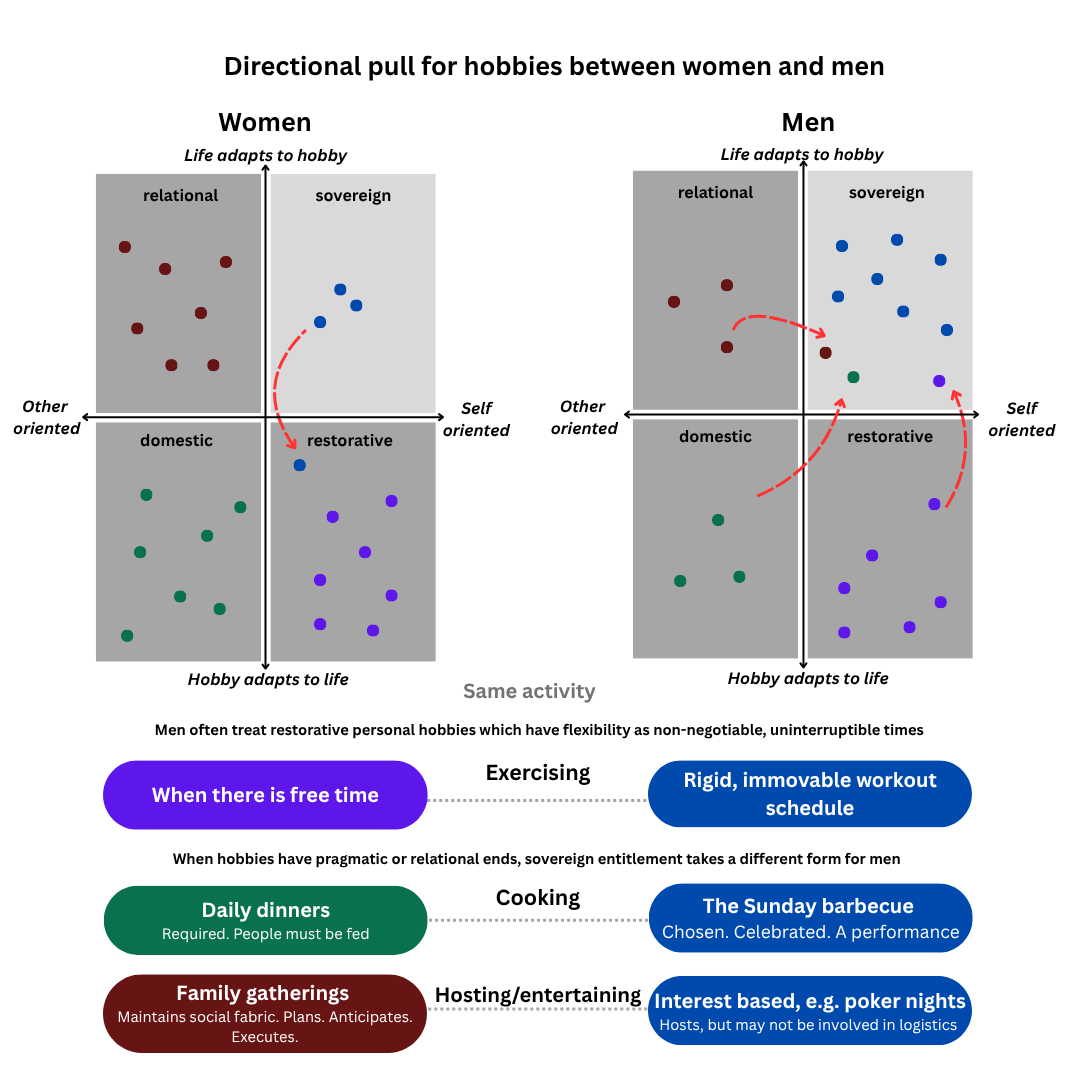
The matrix and the quadrants only tell half the story. What is also determinative is the psychological posture the person brings to it. Because men and women do not simply sort themselves into hobbies in different quadrants and stay there. What actually happens is akin to a gravitational pull, requiring women to have flexibility around sovereign hobbies, while men get to protect time even for non-sovereign hobbies.
Think about a man who does yoga, a flexible, self-adapting hobby by any objective measure. He is likely to treat that class as a non-negotiable appointment the rest of the household simply schedules around. Now think about a woman training for a marathon. By structure, this should be a firmly self-serving hobby — long runs, a training schedule, races on the calendar. But the first time a child gets sick, the long run goes. The first time she senses her absence is inconvenient to anyone, she starts apologizing for the Saturday mornings she needs. And slowly, without anyone explicitly asking her to, she renegotiates the hobby down, shorter runs, fewer of them, less ambition, more flexibility, until it has drifted from the fourth quadrant back into the third, and then sometimes out of view entirely.
The entitlement pivot
Men often treat third-quadrant hobbies with fourth-quadrant entitlement. The activity doesn't structurally require their full absence or total priority — but they claim it anyway. They elect to be unreachable. They decide, without negotiation or announcement, that this time is theirs. Women in the same hobby would rarely grant themselves that election without a conversation, a justification, a cost calculation first. Even when men partake in relational or domestic hobbies, they are still doing so in their own terms. Cooking is voluntary, confined to Sunday barbecues, when they feel like it, when there is opportunity to perform. Super Bowl Sundays and poker nights may be hosted by men, but the food and drinks are still usually planned by women.
I watched how this played out while preparing for the surf camp. My husband and I were both starting personal training for the first time, mine driven entirely by this condensed 6 week conditioning and a fear of re-injuring my back, his to get healthy. I was dedicating two days a week with the personal trainer and an additional 3-4 days for swimming to build enough strength and stamina for pop-ups. He scheduled three sessions a week, two of them at 8 a.m. on weekdays, plus solo treadmill runs during weekdays at the same hour for what he calls consistency. He decided all of this in the middle of our house renovation, which left me fielding contractors and approvals while he was at the gym four of the five weekdays. When I initially asked him to shift some of his times, his answer was “no”. It took a second, more direct conversation from an exasperated me after I was juggling too many things in his absence and snapped. I requested more sternly for him to move his times, while also stating to him that it was not my job to plead my case when I had asked him the first time to move his times, he should have been curious enough to think why his wife would make the request, or to ask her before saying no. His response finally: “you're right, I should have thought about it more. I wasn't thinking.” He conceded by moving his runs to the evenings. The not thinking, the reckless ease, is the problem. I shouldn't have had to ask twice or wait until a disaster occurred for him to realize this. And the moment I got back from this trip, I dropped personal training to once a week. His routine continued.
What's happening is not simply that men choose different hobbies. It is that men treat their hobbies — whatever they are — as non-negotiables, while women treat theirs as provisional. Men bring an entitlement to leisure that operates almost independently of what the activity is. Women bring a posture of permission-seeking and when they push back, as I did, they are made to feel they are asking for something extraordinary rather than basic consideration. The result over time is a gravitational pull: men drift upward toward the fourth sovereign quadrant regardless of what their hobby is. Women’s participation in sovereign hobbies get pull downward towards the elective.
Before we assign blame to women for not pursuing sovereign hobbies, as is often the next step, we have to look at what they stand to lose when they do. If a woman comes home from a week long trip away to a messy house and a partner recounting his suffering, she will do a cost calculation before the next trip. Sovereignty over your own time is only possible when someone is willing to hold life together in your absence — and for most women, that person either doesn't exist, or makes sure you know the cost.
The women on this trip sharpened all of this for me. The vast majority of the experienced, serious surfers were young and unmarried, seemingly unencumbered by domestic responsibilities. The most interesting group were the married mothers. One was an experienced surfer returning to a sport she had loved for years. Another was seventy — she had picked up surfing in her late fifties and caught her first green wave at sixty. She probably didn't have time for this when she was younger. Other mothers were brand new, trying surfing for the first time. For several of them, this was their first time away from home since having children.
I thought a lot about what negotiations had happened at home to make these trips possible for the women, if I already had to do so despite being childfree. What favors did they have to call in? What guilt managed? What cases were made? And sure, even if the husbands may have been supportive enough to let them go, some didn't let them forget how stressful managing home life had been in their absence, as though this were somehow a foreign concept for the women — as though these mothers had never once been the parent who stayed, who managed, who figured it out, without anyone remarking on it.
The hostility women face once they arrive
There is a second force keeping women out of the sovereign quadrant, and it operates not from home but from within the hobbies themselves. Hobbies in the sovereign quadrant are often already coded as male. I spoke with a woman in her mid-twenties who had been a surfer — had loved it, built her identity around it. She described it in the past tense. Her light for surfing, she said, before this trip, had gone out. When I asked why, she told me that surfing with men can be quite hostile and territorial. She read aloud to me the incidents that have occurred at her local surf spot; that fights breakout in the middle of the Pacific waters. The aggression, the territorial posturing, the sense that she was always on the outside of something that wasn't going to welcome her in. It was gratuitous, and so she opted out.
My father-in-law, an avid golfer at ninety-three, has described for years how women who play with their husbands at the club are told to hurry up, to never hold the men up, while the men themselves rarely follow the advice they dispense so freely. The message, delivered not once but constantly, is that you are a guest in a space not built for you, and your presence is tolerated at best.
The effect is the same whether it happens in a surf lineup or on a golf course: women who choose to pursue sovereign hobbies get driven back out of it. It is not just that they were never invited in. It is that some pursued, and were made to feel unwelcome until they left.
The productivity myth
Set aside the external forces for a moment, an unsupportive partner at home, a hostile line-up, another thing that keeps women from the fourth quadrant, and it lives entirely inside us, indoctrinated by society. Women have been so thoroughly trained to experience purely self-serving time as requiring justification that we unconsciously choose hobbies whose output provides that justification. I saw it in myself the moment I recognized it in others. My need for efficiency — my insistence that my time off still be productive, it wasn't just a personality trait. It was patriarchal programming. I had internalized the requirement to prove that my leisure was worth something beyond my own experience of it.
A woman who knits has something to show for her time. A woman who bakes can offer something to the table. A woman who volunteers can point to a cause. Even a woman who runs can frame it as staying healthy for her family. But a woman who surfs, who wakes before dawn to chase a swell that only she will experience, whose only output is her own joy and exhaustion, has to answer a harder question. She has to say: I wanted to.
We are so conditioned to feel needed that we rarely get to ask what we want for no other reason than that we want it. Wanting something purely for yourself requires more courage than it should. Not because anyone forbids it, but because the internal accounting most women carry, the ongoing tally of whether you are giving enough, present enough, useful enough, makes purely self-serving time feel like a debt you haven't yet earned the right to run up.
I negotiated my own version of this to get here. I left in the middle of renovations, but yet again as I noticed, not before most decisions had been made and I had arranged things so my involvement wouldn't be needed. I still left. But I find myself wondering: would I have gone if it hadn't been my friend's fortieth birthday? Would I have simply said "good luck" and walked out the door on my own behalf? I've learned to leave. But I'm still doing the calculations, still negotiating my own exit, rather than simply taking it, the way most men do, without a second thought.
There is a reason women were never taught that ease. While productivity asks women to prove their time worth something, we are also taught to be selfless. These are not two separate virtues, it's the same instruction, delivered twice. The first is a positive form: be useful, produce something, make sure your time off earns its keep. The second is the negative form, Do NOT want too much. Do NOT take too much. Do NOT be the woman who puts herself first. Do NOT be selfish.
There is something worth sitting with in the word "selfish." We use it as an accusation, but what it actually describes is a person who treats their own experience as worth protecting. A person who, when the waves arrive at 4 a.m., gets up and goes. A person who, for a few hours, lets the emails wait and the chores accumulate and trusts that the world will hold together while she is in the water. In other words, sovereign hobbies are selfish — but only if you’re a woman.
Men who surf are not typically called selfish. They are called serious about their sport. The same activity, the same pre-dawn alarm, the same unanswered responsibilities, but on a woman, it reads differently. The same behavior carries a different social weight depending on who is performing it and what they are presumed to owe.
Even when no one outside is calling her selfish, she is often calling herself that. The gravity doesn't require an external enforcer. After enough years of absorbing the message that her time is the household's time and her leisure is the household's leisure, a woman will enforce it herself, rescheduling her own run, canceling her own trip, quietly editing her ambitions down to a size that doesn't inconvenience anyone.
Studies have shown that women spend considerably more time on household activities, caregiving, and personal obligations, and consequently, less on leisure and sport. The leisure women do manage is rarely truly free. Our leisure is usually time boxed, and in the background is a pressure to return to responsibilities. Women do not get to check out and immerse themselves into the sovereign hobbies with the same reckless ease that men do. This reflects how a woman's time is perceived by society. Where men get to compartmentalize their time and carve out a clear delineation of “hobby time”, women can only do so when she can prove that she has fulfilled her responsibilities, and to not miss anything while she is gone, and to be ready to answer any questions even during her time off, and then to resume or even pick up the mess that was created while she was away.
The sovereignty that the fourth quadrant demands, protected time, full presence, someone else holding the fort, is not a luxury women are culturally presumed to need or deserve. It is, in fact, almost precisely the opposite of what a good woman is supposed to want. A good woman is productive. A good woman is not selfish. Her time is elastic, available, oriented outward. The idea that it might belong entirely to her, for no useful reason, is not just unusual. It is, in the oldest and most loaded sense of the word, unfeminine.
Which is exactly what makes it so radical when women claim it anyway. Not loudly, not always permanently, but in the specific and ordinary act of showing up to the lineup, to the tee, to the 4 a.m. alarm, and deciding that this time, the world can wait.
During one of my last days, the swell came in better than the forecast had promised. The water was warm and the light was still low, and I was standing chest-deep waiting for the next set, feeling the pull of each passing wave move through me before it broke. And somewhere out there, between one wave and the next, the hobby matrix and the gendered patterns and the cost calculations simply released. What replaced them was just this: Pop-up. Back left foot. Front right foot. Stay low. Ride.
I wasn't asking for permission. I wasn't running numbers. I was reading waves. That, I think, is what sovereign hobbies are actually teaching women who claim them. Not just how to surf or golf, but how to occupy your own experience completely, without footnotes, without justification, without the ongoing internal audit of whether you have earned the right to be exactly where you are. Claiming them requires a woman to decide, against everything she has been taught, that her hobby is worth protecting. That “I wanted to” is a complete sentence. That it is, in fact, the only sentence required.
The wave comes. You either go or you don't.
For one week in Nicaragua, I went.
Wow. I love this so much. Also cringing because my first reaction was “I need to develop a sovereign hobby,” which was immediately followed by “but I probably need to wait a few years, til my kids are older.”
Anyway - thank you. I’m saving this to return to later!
I love this so much as a 70 yr old retired woman. Male contractors and sales reps particularly think I'm avaliable for them to ‘just stop by.’ So now I translate my hobby time and pleasure time into ‘patriarchy time.’ “No, I'm on at Zoom.” “I have a client meeting.”